

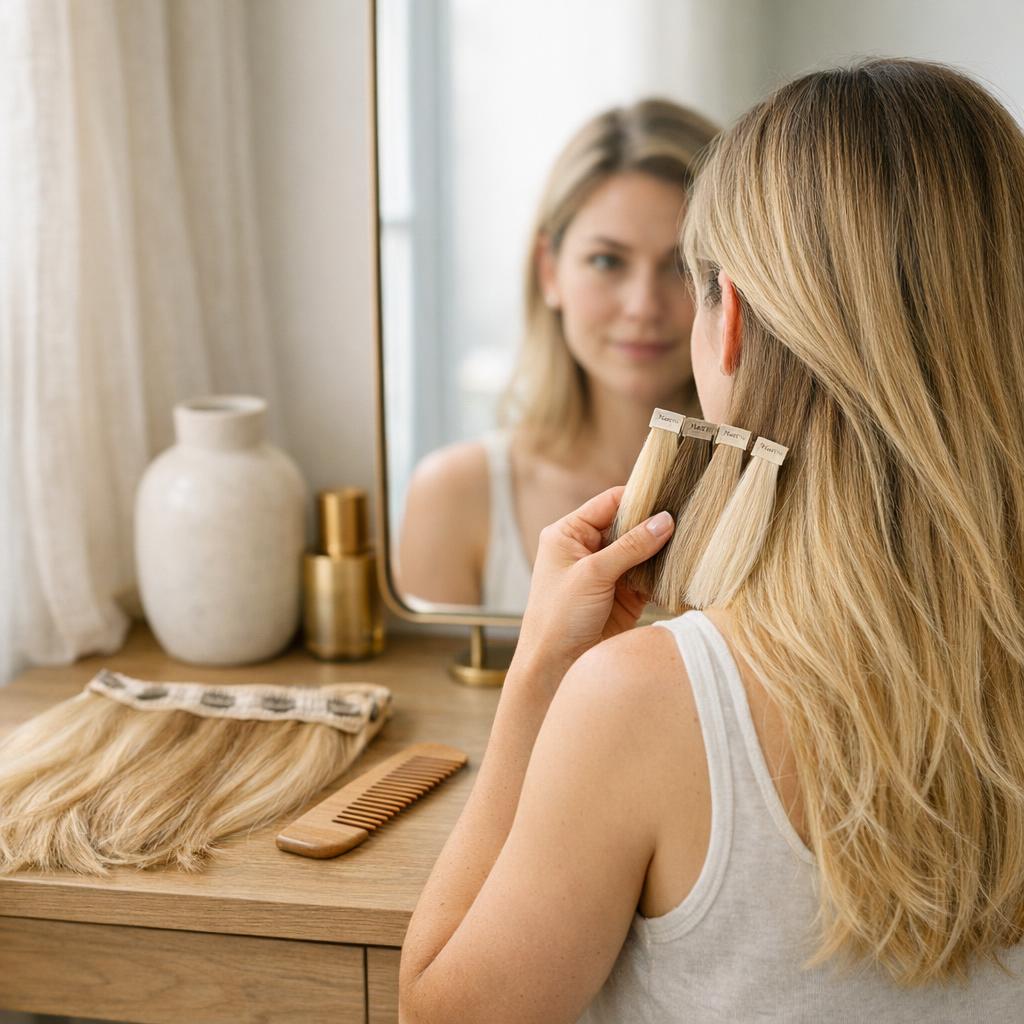
A good color match makes the difference between clip-in extensions that remain visible and extensions that blend seamlessly into your own hair. Especially when shopping online, it can be difficult to determine which shade matches best. You often see multiple nuances in your hair, from darker roots to lighter lengths or subtle highlights. That is precisely why matching the color of clip-in extensions involves more than simply choosing a color that is “approximately right.” It is about the undertone, the way the light falls, the part of your hair you match, and the effect you want to achieve: more volume, extra length, or both.
At Luxury for Princess, you have several tools to help you. These include a personal color match based on photos taken in natural daylight via Help me choose – personal color advice, a color ring, sample pieces, and, with full-set clip-in extensions, a tester weft for comparing at home. This allows you to determine much more accurately which hair extension color to choose and avoid a disappointing purchase.
How do you find the right color for clip-in hair extensions?
You should not choose the right color for clip-in hair extensions based on a single strand or just the ends. Look at the overall appearance of your hair. The best match usually corresponds with the middle section and lower layers of your own hair, because that is where clip-in extensions are placed. If you have noticeable regrowth or balayage, it is natural for your roots to be darker than your lengths. In that case, the extension color does not need to match your roots exactly.
Also pay attention to your hair's undertone. Two blonde shades can appear equally light, yet look completely different if one is warm and golden while the other is cool or ash blonde. The same applies to brown, red, and black shades. A color may look close on paper, but still appear unnatural if the undertone is not right.
Would you like to view all blonde shades and undertones side by side? See Blonde hair extensions – shades and undertones.
- Match primarily to the section where the extensions will blend.
- Always check the color in natural daylight.
- Pay attention to the undertone: warm, cool, or neutral.
- Take highlights, lowlights, and color transitions into account.
- When in doubt, choose a multi-tonal shade that blends beautifully with multiple nuances.
Luxury for Princess uses a multi-tonal adaptive coloring system. This is especially useful when your hair color does not consist of one flat shade, but instead has multiple tones.
What should you match: roots, lengths, or ends?
A frequently asked question is whether hair extensions need to match your own hair in color from top to bottom. For clip-ins, the answer is usually no, not completely. Because clip-in wefts are placed underneath your own hair, they mainly need to blend well with the lengths and ends that fall over them. If you match only the darkest roots, you risk the extensions looking too dark at the bottom.
If you have an even color without a visible gradient, matching is simple: choose a shade that is as close as possible throughout. If you have an ombre, balayage, or much lighter ends, focus mainly on the area where the extension will be visible once your hair falls over the wefts. For face-framing strands or shorter layers, it may be smart to also consider the shade around the front when assessing the match.
If you mainly want to use clip-in extensions for volume, matching your own lengths is most important. If you want to add length, the transition between your own hair and the extensions should be as seamless as possible. In that case, both the color and the blend are important.
Should clip-in hair extensions be lighter or darker?
In most cases, clip-in hair extensions don’t need to be intentionally chosen lighter or darker, but should be as close as possible to the dominant shade in your hair. However, there are situations where a slight variation works better. If your hair contains multiple shades, a slightly lighter or slightly darker extension may blend in more beautifully than a flat “perfect” color that looks too even.
If you have lots of highlights or lighter ends, a slightly lighter shade often works better than a color that is too dark and becomes visible underneath your hair. If you have a deep, full hair color without much dimension, a slightly darker match may look more natural than a shade that turns out too warm or too light. The most important thing is that the overall look works in daylight.
- Don’t automatically choose a lighter or darker shade; look at your color gradient.
- With balayage and highlights, a multi-tonal or slightly lighter blend often works beautifully; see Balayage hair extensions – multi-tone color options.
- With even dark hair colors, an extension that is too light will be noticeable more quickly.
- When in doubt, a match that blends with the lengths is usually safer than matching only the roots.
How to determine your hair color online as accurately as possible
Determining the color of your extensions online works best when you look at your hair as it really is, not as it appears under bathroom lighting or with a phone filter. Artificial light often makes hair look warmer or darker. Direct sunlight can make colors look lighter or more vivid. That is why soft, natural daylight is the best basis for an accurate assessment.
Leave your hair loose, brush it thoroughly, and look at multiple sections: the roots, the middle, the underlayer, and the ends. If your hair has been colored recently, also take fading or a difference between the top layer and the lower layers into account. Especially with blonde, ash blonde, and brown shades with highlights, you often see more nuance than you expect beforehand.
Are you unsure between two colors? Then it is smart to look not only at how dark or light a shade is, but also at its shine and warmth. A neutral or multi-tonal color often blends more beautifully than a shade that is too cool or too warm and falls just outside your own hair color. If you need extra help choosing the right color, it can remove a lot of uncertainty.
Taking photos for a personal color match
A personal color match is one of the quickest ways to find the right color online, provided your photos are clear enough. Therefore, send photos of your hair in natural daylight, without filters, editing, or flash. Make sure your hair is visible from the roots to the ends. This makes it easier to assess what your color gradient looks like and which clip-in shade best matches it.
It is better to take multiple photos than just one. Consider a photo of the back, a side view, and possibly a close-up of your lengths. If there is a significant difference between the top layer and the underlayer, an extra photo with your hair slightly swept to the side can also be helpful. The more realistic the photo, the more accurate the color advice.
What you should do
- Take photos in natural daylight.
- Leave your hair loose and comb it thoroughly.
- Photograph your hair from the roots to the ends.
- Preferably send multiple angles.
- Indicate whether you want clip-ins for volume, length, or both.
What not to do
- Do not use filters, portrait mode, or heavy image editing.
- Do not take photos in direct sunlight, shade, or yellow artificial light.
- Do not photograph wet, greasy, or tightly tied-up hair.
- Do not send only a close-up without showing the full color gradient.
At Luxury for Princess, you can use a free color match for this. That makes it easier if you are unsure which color extensions you need.
Sample piece, tester weft of color ring: what suits your situation?
If you want extra certainty, physical color aids are often the smartest choice. Luxury for Princess offers several options for this. The best option depends on how much certainty you want and whether you use extensions more often.
Sample piece
A sample piece or mini color sample is useful if you want to hold one or more shades next to your own hair at home. This works especially well if you are choosing between two colors or if your hair has multiple nuances that are difficult to see on a screen. In that case, you can Order a color swatch – be sure of your match.
Tester weft
Full-set clip-in extensions include a tester weft. This allows you to assess the color at home before using the full set. It is ideal if you already have a strong preference for a shade but want to check that the blend looks right in real life.
Color ring
A color ring is mainly practical if you want to compare very precisely or work with extensions more often. You can hold multiple shades directly next to your hair and see more clearly which color, depth, and undertone match best. If you want to compare many colors, Color ring – all colors in one overview is a practical option.
For most consumers, the combination of photo advice plus a sample piece or tester weft is more than enough to color match clip-in extensions properly.
What color extensions do you need for highlights, balayage, or regrowth?
With highlights, balayage, or regrowth, you rarely need to copy the darkest or lightest color exactly. More important is that the extensions logically blend with the part of your hair where they will be visible. If you have dark roots and lighter lengths, a color that blends with your mid-lengths and ends is usually the best choice.
For subtle highlights, a multi-tonal color often works beautifully because it already contains several natural nuances. With a strong balayage or a clear transition, it may be smart to choose a shade that follows the base color of your lengths. This helps prevent a harsh line between your own hair and the extensions.
If your hair is very short at the front or has lots of layers, the blend may turn out differently than with long, one-length hair. In that case, a tester weft or sample piece is especially valuable, because you can immediately see at home how the color works with your hairstyle.
Common mistakes when color matching clip-in extensions
- Only match the roots when the extensions are visible in the lengths.
- Choosing a color based on studio photos or screen brightness.
- Ignoring the undertone and looking only at lightness or darkness.
- Taking photos with filters, flash, or warm artificial light.
- Assuming your hair is one color when it actually contains multiple nuances.
- Not considering the purpose: adding only volume sometimes requires a different focus than adding extra length.
FAQ about matching the color of clip-in extensions
How can I determine the color of my extensions?
View your hair in natural daylight, pay attention to the undertone, and match mainly to the lengths and ends where the clip-in extensions will blend. If you're unsure, you can request a personal color match or use a sample piece.
Do hair extensions need to match your own hair in color?
Yes, but not necessarily an exact match from roots to ends. For clip-ins, the most important thing is that the extensions blend beautifully into the visible part of your hair. With color variation or highlights, a seamless blend matters more than a hundred-percent identical solid color.
How do you find the right color for clip-in hair extensions when you're choosing between two shades?
First look at the undertone, then at the color variation in your hair. If you're still unsure, a sample piece, color ring, or tester weft is the safest way to compare at home. A free color match based on daylight photos can also help you make a more informed choice. If you want to see how shades blend into real hair first, take a look at the Before & after photos – see colors in real hair.
Should I choose human hair or synthetic clip-in extensions if color is important?
Both can match beautifully, as long as you choose the right shade. Human hair clip-in extensions often provide the most natural blend and styling flexibility. Synthetic clip-ins can also offer a beautiful color match, but it is especially important to be sure of the right shade beforehand.
Does a multi-tonal color really work better?
For many hair colors, yes. Because natural hair is rarely completely uniform, a multi-tonal shade can create a softer, more natural transition. This is especially useful for highlights, balayage, and hair colors with subtle variations in tone.
What if my hair is darker at the roots than at the ends?
Then you usually don't need to match the roots exactly. Choose a color that matches the lengths and ends, because clip-in extensions are mainly visible there. This generally creates a more seamless and natural-looking blend.


