

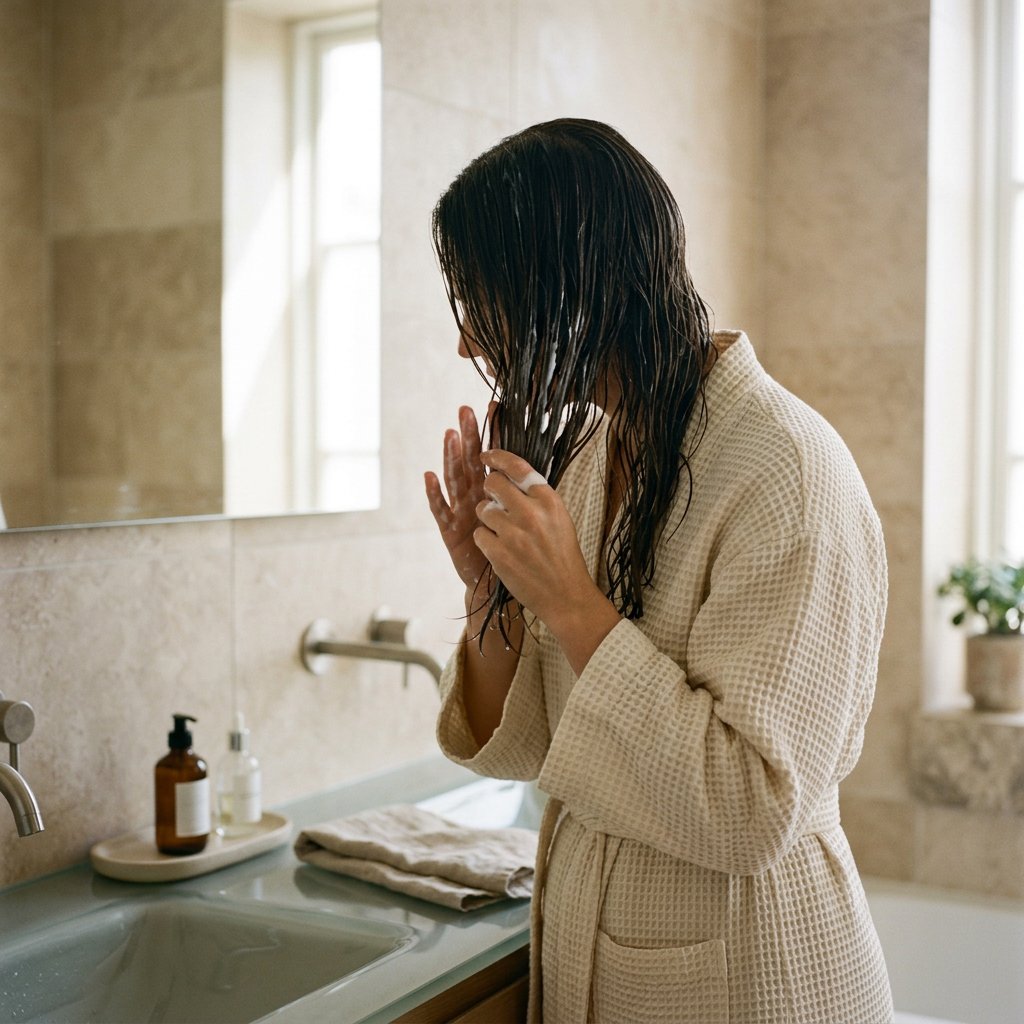
What does a hair mask do for your hair?
A hair mask provides intensive conditioning and, depending on the formula, can make your hair softer, smoother, and more manageable. You might notice this when detangling: your comb glides more easily through the lengths, and your ends feel less rough. This makes your hair easier to care for and style.
A mask works with conditioning ingredients that attach to the hair. They help reduce friction between strands and leave your hair feeling smoother. The formula determines the effect. A rich formula with oils feels different from a lighter treatment. It's not about choosing the thickest mask, but finding a formula that suits what your hair needs.
Dry, coarse lengths and frizzy ends are reasons to consider extra conditioning. Your hair may also feel rougher and tangle more easily after bleaching. A mask can help those lengths feel better. Look at your hair as a whole: your roots may get oily quickly while your ends are dry. You don't need to apply the same treatment everywhere.
Conditioning is not the same as permanent repair. A mask can make damaged hair feel smoother, but it doesn't undo the damage. A conditioning product won't fuse split ends back together, either. Trimming removes the split portion; a mask conditions the lengths you keep. This way, you can care for your hair without expecting more from a product than it can deliver.
Do you use a hair mask before or after shampooing?
A standard rinse-out mask goes on after shampooing. Shampoo removes oil, dirt, and styling product residue. Then you distribute the mask through your clean hair, applying the treatment where it's needed. Choose a mild, sulfate-free cleanser before you mask—see our Gentle shampoos. Focus on washing your scalp and let the lather run through the lengths as you rinse, without rubbing them together vigorously.
Once the recommended time is up, rinse the mask out with water. Don't shampoo again afterward: that would wash away some of the conditioning treatment you just applied. Using a mask before shampooing is appropriate for a treatment designed for that purpose. If the product specifies this use, follow that order. It's not a general rule for every hair mask; a pre-shampoo treatment and a standard rinse-out mask each have their own place in your routine.
How to apply a hair mask carefully
- Gently squeeze excess water from your freshly washed hair, unless the label specifies a different preparation. Don't wring your hair out or rub it vigorously with a towel.
- Use an amount suited to your hair's length and thickness and the product instructions. Start with a little: it's easier to add more where needed than to remove excess product from your hair.
- Distribute the mask evenly through the lengths and ends. If you have a lot of hair, work in a few loose sections so you reach more than just the outer layer.
- Only apply a mask to your scalp if it's designed for that purpose. Then leave the product on for the recommended time.
- Rinse thoroughly with water. Make sure you also remove the product from the underneath layers and at the nape of your neck so no unwanted residue remains.
After rinsing, you can seal in moisture with a few drops of oil for extra softness and shine—learn more in How to use hair oil.
How long should you leave a hair mask on?
The correct treatment time is listed on the product and is specific to that formula. There is no set number of minutes that works for every hair mask. If helpful, set a timer once you've finished distributing the mask. This gives the treatment its intended time without having to guess while you're in the shower.
Leaving it on longer doesn't automatically provide extra conditioning. A formula is developed for a specific use; a longer treatment doesn't turn a rinse-out mask into a more intensive version.
Don't leave a rinse-out mask on overnight unless the manufacturer specifies that use. An overnight treatment or leave-in is a different type of product. Choose the treatment time based on the product, not on how much time you have or how dry your hair feels.
Do you still need conditioner after a hair mask?
You can combine a hair mask and conditioner, but conditioner isn't automatically necessary after a mask. Conditioner is designed for regular care and helps keep your hair manageable after shampooing. A mask is a more intensive conditioning step. Their functions overlap, even though their formulas and instructions differ. For lighter hydration on days you skip a deep mask, browse our Conditioners.
Whether both products offer a benefit depends on the formulas and how your hair feels. If the mask already leaves your lengths soft and easy to comb through, another layer of conditioning may not add anything. If detangling is still difficult and conditioner fits into the product routine, you can use that extra step. The goal is well-conditioned hair that feels good, not applying as many products as possible one after another.
If you use both, the order is: first leave the mask on for the recommended time and rinse it out, then apply and use conditioner according to the product instructions. Applying a mask after conditioner is not the standard order. Focus the conditioner on areas that need extra manageability. This keeps every step purposeful and helps you avoid coating all your hair in another rich layer of conditioning out of habit.
How often should you use a hair mask?
Always prioritize the product instructions. The frequencies below are starting points; how your hair feels between washes can help you adjust your routine.
| Hair type or condition | Cautious starting point | Sign to adjust |
|---|---|---|
| Dry or damaged hair | About once a week | Lengths that stay rough: adjust your conditioning routine to better address the dryness. |
| Normal, healthy hair | Once every two weeks, if needed | Hair that stays soft and manageable: keep your routine simple. |
| Fine hair | Once every two weeks with a lightweight formula, if needed | Heavy or limp hair: use less often or choose a lighter conditioning treatment. |
| Curly hair | Weekly when dry; every two weeks may be enough when dryness is minimal | Adjust based on dryness and manageability, not just curl type. |
When does your mask need a different approach?
The specific product determines how to use it. This also applies if you want to know how to use a Garnier hair mask: follow the instructions for that particular version. One brand can have several formulas, each with its own preparation, amount, and treatment time.
Some products list multiple uses, such as a rinse-out treatment and a leave-in. Use the amount and method specified for your chosen application. A mask that needs to be rinsed out doesn't become a leave-in simply because you use less.
Applying a purple toning mask to dry hair isn't a universal method, either. Pigmented products differ in how much color they deposit, and dry hair can absorb pigment differently than wet hair. Follow the preparation and treatment time the manufacturer recommends for that specific purple mask instead of borrowing a method from another product.
Wear extensions? Tailor your care routine to them
Choose a mask that suits the material of your extensions. We offer both Remy human-hair extensions and synthetic extensions. Human hair and synthetic fibers need appropriate care, so a mask for your own hair isn't automatically suitable for both materials.
Follow your extensions' care instructions when choosing and applying products. With attached extensions, the attachment points need attention, too. Distribute a suitable mask through the recommended lengths and ends, and don't apply it to tapes or other attachments unless instructed. Caring for the hair and caring for the attachments are separate considerations. If you wear clip-ins, get step-by-step guidance in Wash and care for clip-in extensions.
Explore our Hair care for extensions to tailor your routine to your extensions, their material, and how you wear them.


