

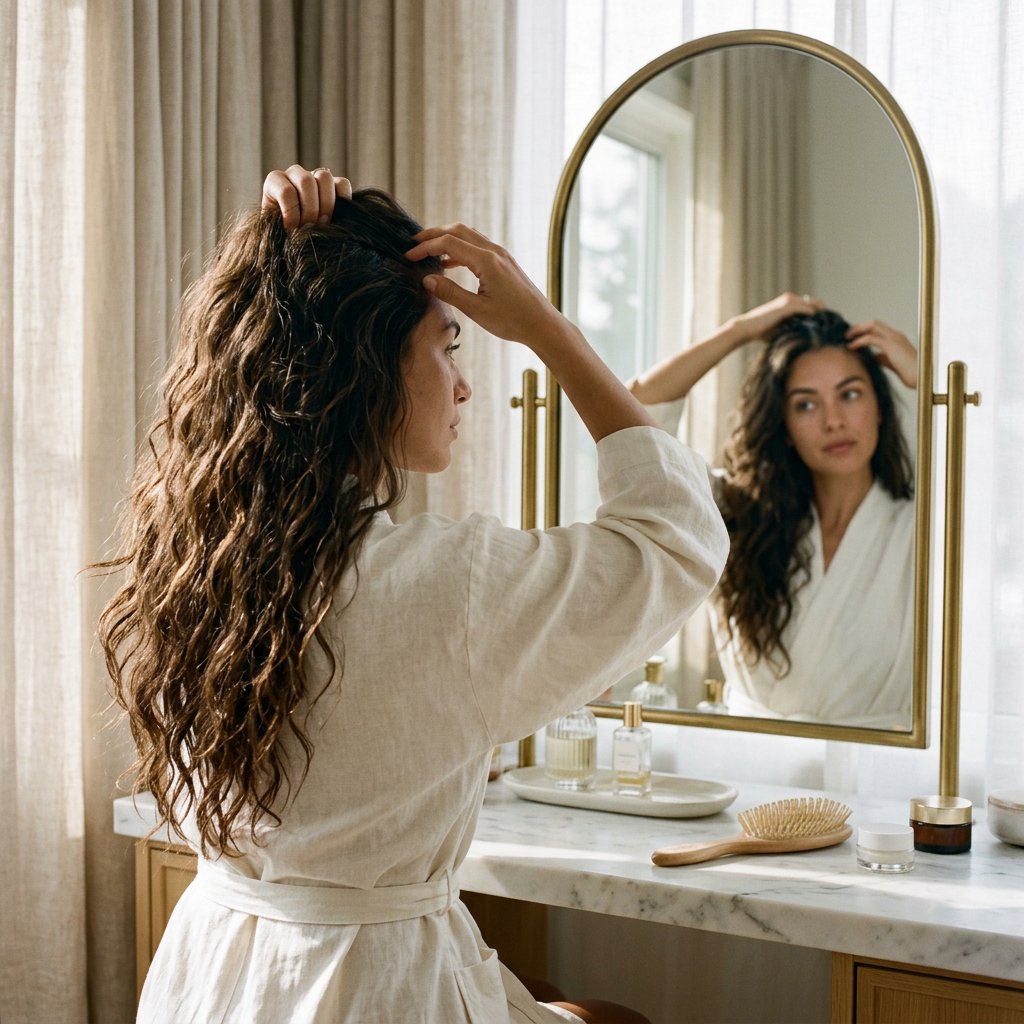
Start at your roots, not your lengths
Part your hair into small sections and treat the oily areas. This puts dry shampoo where you need it without adding unnecessary roughness to your lengths.
-
Start with completely dry hair. Gently detangle it, working from the ends upward. Then use your fingers or a comb to create sections at the crown, along your part, and around your face. Lift each section so you can easily reach the roots underneath. Divide your hair into several small sections rather than one large section.
-
Prepare the product. Shake a spray according to the package instructions so the ingredients mix well. Aim the nozzle at the exposed roots, not all over the surface of your hair. With loose powder, a dispensing opening helps you apply the product precisely to the area you want to treat.
-
Apply small amounts. When using a spray, follow the distance recommended on the label; for many sprays, this is about twenty centimeters. Use short bursts rather than one continuous spray. Apply loose powder sparingly at the roots. Avoid dry lengths and ends: absorbent powder mainly adds extra roughness there.
-
Give the product time to work. Follow the waiting time on the label; many dry shampoos need about two to five minutes. The absorbent particles need that time to soak up sebum. Brushing immediately removes the product too soon. Spraying more right away makes it harder to judge the results: wait until you see what the first application does.
-
Distribute and finish. Gently massage your roots with your fingertips and carefully brush out visible residue with extension-friendly hairbrushes, especially if you wear extensions. For curls, work your fingers between the roots to preserve your curl pattern. A white cast can result from using too much product or spraying too close, for example. Cool air from a blow-dryer helps disperse loose residue; keep the airflow moving while working your fingers through the roots.
How does dry shampoo work?
Dry shampoo is a hair product containing absorbent ingredients, available in forms such as a spray or loose powder. Ingredients like starch, silica, or clay absorb excess sebum. This makes the roots look less oily and keeps strands from clumping together as much.
Sebum is the natural oil your scalp produces. It helps keep your skin and hair supple. When it builds up at the roots, your hair can start to look flat. The absorbent particles soak up some of that oil, making your hair look less weighed down. The product mainly changes how your roots look and feel.
The absorbent ingredient is separate from the application method. A spray distributes the formula as a fine mist; loose powder is applied without a spray mechanism. Ingredients also vary within the same product format. Two aerosol cans may contain different powders, fragrances, and color pigments. The packaging alone doesn't tell you how the formula is made.
When should you use dry shampoo?
Dry shampoo works well when your roots get oily between washes while the rest of your hair still looks good. Think of bangs that look oily sooner, strands around your face, or a morning when you don't have time to wash and dry all your hair. You can treat just that small area.
In the morning, use dry shampoo to freshen up your hair before heading out. Applying it before bed gives the product more time to absorb sebum and distribute through your hair. Style your hair again the next morning. The timing that works for you depends on when your roots get oily and how you wear your hair.
After a workout, let sweat and moisture dry completely first. Powder can clump on damp roots, making it harder to distribute evenly. Let your hair dry loose or use cool airflow.
You can also use dry shampoo preventively, just before your roots become noticeably oily. Focus on the areas that tend to get oily quickly. If there's still product in your hair and it looks fresh, you can skip another layer.
Which dry shampoo is right for your hair?
Choose product features that suit your hair's thickness, color, and scalp needs. Light-colored powder can make dark hair in particular look dull and ashy. The right formula makes finishing your style easier.
| Hair need | Suitable product features | What to consider |
|---|---|---|
| Fine hair that gets weighed down easily | A lightweight formula with fine, even distribution and minimal heavy styling feel. | Keeping the roots light and airy. |
| Very oily roots | An absorbent formula with a spray nozzle or powder opening that lets you control the amount. | Targeted application to individual oily areas. |
| Thick or curly hair | A formula that can be applied directly to specific areas at the roots. | Reaching the roots and preserving the curl pattern. |
| Blonde hair | A clear or blonde-tinted formula with a suitable undertone. | Matching cool, neutral, or warm blonde tones. |
| Brown or dark hair | A clear formula or color pigments that match the hair color. | Possible transfer of tinted powder onto hands and fabrics. |
| Color-treated hair | A formula labeled as suitable for color-treated hair. | Care instructions for your specific color treatment. |
| Sensitive scalp | A fragrance-free formula without ingredients you've reacted to before. | The ingredient list on the label identifies fragrance and other ingredients. |
Use dry shampoo for more volume and grip
- Use the texture as a styling aid. Absorbent powder gives strands more grip, even when they aren't visibly oily yet. This makes them less likely to slip past one another.
- For volume, work beneath the top layer of hair, close to the roots. Then lift the roots with your fingers. The top layer falls over it, keeping the finish soft.
- Give a ponytail a fuller base or create more grip for pins in an updo. Dry shampoo is different from texturizing spray: the first focuses on absorbing sebum, while a texturizing spray is mainly intended to create shape and texture.
How often should you use dry shampoo?
How often you use dry shampoo depends on the product instructions, how much you apply, and how your scalp feels. There's no fixed daily schedule that works for everyone. With repeated applications, powder, scalp oil, and other styling residue continue to collect in your hair.
A heavy product feel, visible residue, or itching are reasons to wash rather than spray again. Stop using the product if irritation persists. If symptoms continue, a primary care doctor or dermatologist can assess the cause.
Remove buildup with a shampoo that suits your hair and scalp. Wet the roots thoroughly, distribute the shampoo over your scalp with your fingertips, and rinse carefully. Pay particular attention to the areas where you've applied dry shampoo, without scratching hard. For stubborn buildup, a clarifying shampoo may be an option, depending on your hair type and any color treatment. This more intensive cleansing isn't automatically necessary for a regular wash. If you wear extensions, choose gentle shampoos for extensions to cleanse buildup without drying them out.
The order is shampoo for the scalp first, followed by conditioner for the lengths and ends. This lets you cleanse the roots first, then condition the hair. If the product instructions call for a specific pretreatment, use it before washing.
Have extensions? Follow your care instructions
When using dry shampoo with extensions, take the material and attachment method into account. Your natural roots, the extension hair, and the attachment points each need a different approach. Our range includes both Remy human-hair extensions and synthetic extensions; care varies by material.
Follow the relevant caring for and washing tape extensions and don't spray directly onto the attachment points. With clip-ins, too, use only a product suitable for that extension material rather than automatically following your usual routine. For step-by-step advice, see wash and care for clip-in extensions. From our own salon experience, we know how important the right aftercare is. You'll also find hair care for extensions in our range to support the rest of your routine.
No dry shampoo on hand?
Wash specific areas with regular shampoo and water if you want to actually remove oil. Washing just your bangs or the front hairline takes less time than a full wash. Rinse well and dry those strands before styling them again.
If your main goal is to make oily roots less noticeable, choose a ponytail or pin back the front sections. That changes your style but doesn't remove oil. Kitchen powders and other household products aren't equivalent substitutes for a formulated hair product: they differ in distribution, color, and finish. Washing specific areas or adjusting your hairstyle keeps the solution simple.


